
Petrotech Academy | Online classes, learn from anywhere
Primavera P6 for Civil, Mechanical and Electrical Engineers
Oracle Primavera P6 – Project Planning & Scheduling
A professional training programme that develops practical planning and scheduling skills for engineering students, fresh graduates, job seekers and working professionals, with separate civil, mechanical and electrical project applications for EPC, Oil & Gas, Petrochemical, Refinery, LNG and Power projects.
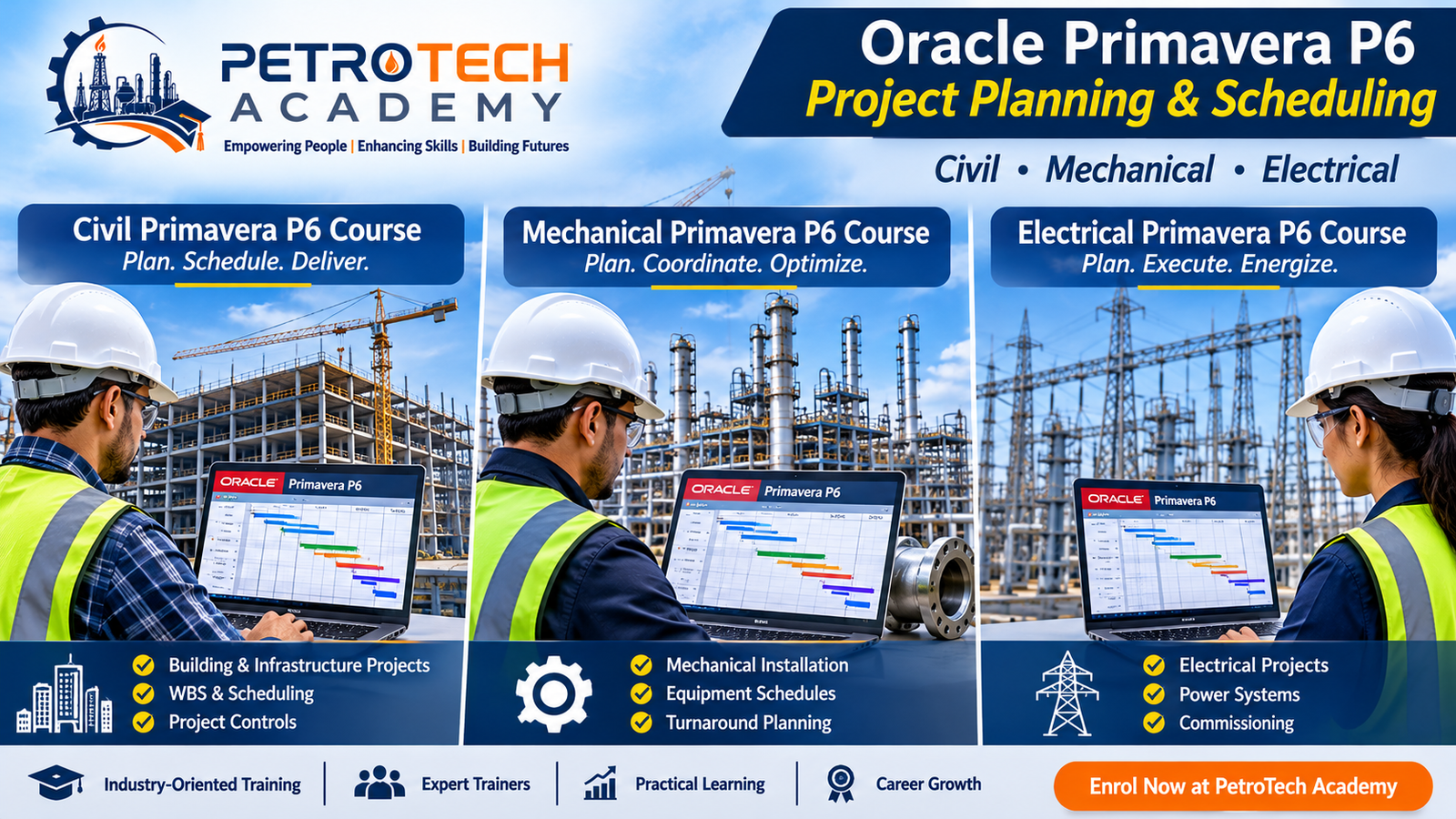
Course overview
About this course
Oracle Primavera P6 is one of the leading project planning and scheduling applications used across major engineering, construction, Oil & Gas, Petrochemical, Refinery, Power and infrastructure projects.
The programme covers the complete planning lifecycle: project initiation and WBS development, activity planning, logical sequencing, baseline preparation, resource allocation, progress monitoring, schedule analysis and reporting. Learners see how P6 is applied in EPC/EPCC projects, construction, engineering and procurement schedules, plant shutdowns and turnarounds.
Training combines software demonstrations, practical exercises, industry-oriented examples and project-based learning.
Who should attend
- Civil, Mechanical and Electrical Engineering students and graduates
- Diploma and B.Tech engineering holders
- Fresh graduates seeking careers in project planning
- Junior Planning Engineers
- Site Engineers and Construction Engineers
- QA/QC Engineers interested in project controls
- Working professionals upgrading their Primavera P6 skills
- Professionals planning to work in Oil & Gas, Petrochemical, Refinery, LNG, Power and EPC industries
Course objectives
Develop the technical knowledge and practical skills to develop, maintain, monitor and analyse project schedules using Oracle Primavera P6. You will learn to:
- Understand project planning and scheduling fundamentals
- Develop project WBS and activity structures
- Create detailed project schedules using Primavera P6
- Apply Critical Path Method (CPM) and activity relationships
- Understand activity durations, calendars, constraints and float
- Develop engineering, procurement and construction schedules
- Establish project baselines and monitor schedule performance
- Perform resource and manpower planning
- Update actual progress and analyse schedule deviations
- Understand Earned Value Management (EVM) and project performance indicators
- Prepare progress reports, S-curves and project dashboards
- Develop recovery schedules and support delay analysis
Course modules
Eight modules that take you from planning fundamentals and P6 setup to CPM scheduling, baselines, resources, earned value and reporting, finishing with project-based practice.
Foundations and Project Setup
Fundamentals of Project Planning & Scheduling
- Project management and project controls fundamentals
- Role and responsibilities of a Planning Engineer
- Project lifecycle and EPC/EPCC execution
- Project planning, scheduling, monitoring and controlling
- Introduction to Primavera P6 Professional
Primavera P6 Project Setup
- Creating and managing projects
- Enterprise Project Structure (EPS)
- Organizational Breakdown Structure (OBS)
- Work Breakdown Structure (WBS)
- Project calendars and activity calendars
- Project coding and activity classification
Scheduling, CPM and Baseline
Activity Development & Scheduling
- Activity creation and coding
- Activity types and duration types
- Original duration and remaining duration
- Activity relationships: FS, SS, FF and SF
- Leads and lags
- Constraints and scheduling options
- Critical Path Method (CPM)
- Forward pass and backward pass
- Early Start, Early Finish, Late Start and Late Finish
- Total Float and Free Float
- Critical and near-critical activities
Baseline & Project Schedule Management
- Developing project schedules
- Schedule review and validation
- Baseline creation and assignment
- Baseline comparison
- Schedule updates and data dates
- Progress monitoring and variance analysis
- Schedule recovery and acceleration techniques
Resources, Progress, EVM and Reporting
Resource & Manpower Planning
- Resource creation and assignment
- Labour, non-labour and material resources
- Resource loading and manpower planning
- Budgeted and actual units
- Resource allocation and levelling
- Resource usage profiles and histograms
- Manpower forecasting
Project Progress Monitoring & Earned Value Management
- Physical progress measurement
- Planned versus actual progress
- Budgeted, actual and remaining units
- Planned Value (PV), Earned Value (EV), Actual Cost (AC)
- Schedule Performance Index (SPI)
- Cost Performance Index (CPI)
- Estimate at Completion (EAC)
- Schedule and cost performance analysis
Reporting & Project Controls
- Layout development and customisation
- Gantt chart preparation
- Look-ahead schedules
- Weekly and monthly progress reports
- Progress S-curves
- Manpower histograms
- Critical path reports
- Schedule variance reports
- Exporting reports to Excel and PDF
Practical Project-Based Training
Practical Project-Based Training
Work on industry-oriented scheduling exercises covering project planning, activity development, logic relationships, resource allocation, baseline management, progress updates and reporting.
Discipline-wise Primavera P6 applications
Practice scheduling the real activities of your own branch, with the execution sequence used on EPC projects.
Civil Engineering Projects
Building construction, infrastructure, industrial facilities and civil works within EPC projects.
- Site preparation and mobilisation
- Surveying and setting out
- Excavation and earthworks
- Foundation and piling works
- Reinforcement and formwork
- Concrete pouring and curing
- Structural steel fabrication and erection
- Buildings and infrastructure development
- Roads, drainage and underground utilities
- Finishing works and handover
Career relevance: Civil Planning Engineer, Junior Planning Engineer, Project Scheduler, Construction Planning Engineer
Mechanical Engineering Projects
Equipment installation, piping construction, fabrication and commissioning in Oil & Gas, Petrochemical, Refinery and LNG projects.
- Mechanical engineering and equipment documentation
- Procurement of static and rotating equipment
- Pressure vessel and heat exchanger installation
- Pumps, compressors and turbines installation
- Structural and equipment foundations interface
- Process piping fabrication and erection
- Welding, NDT and PWHT activities
- Hydrotesting and reinstatement
- Equipment alignment and preservation
- Mechanical completion and commissioning
- Shutdown and turnaround planning
Career relevance: Mechanical Planning Engineer, Piping Planning Engineer, Shutdown Planning Engineer, Project Scheduler, Project Controls Engineer
Electrical Engineering Projects
Electrical engineering, procurement, installation, testing and commissioning in industrial and infrastructure projects.
- Electrical engineering and design documentation
- Procurement of transformers and switchgear
- Electrical panels and MCC installation
- Cable tray and ladder installation
- Cable pulling and termination
- Earthing and lightning protection
- Lighting and small power installation
- Electrical equipment installation
- Insulation resistance and continuity testing
- Transformer and switchgear testing
- Energisation and commissioning
Career relevance: Electrical Planning Engineer, Electrical Project Scheduler, Junior Planning Engineer, Project Controls Engineer
Learning methodology
A practical and structured approach in six steps.
Conceptual Learning
Understand project planning and scheduling fundamentals.
Software Training
Learn Primavera P6 functions through guided demonstrations.
Practical Exercises
Create WBS, activities, relationships, schedules and baselines.
Industry Applications
Understand discipline-wise project activities and execution sequences.
Project-Based Learning
Develop and update practical engineering project schedules.
Career Preparation
Gain exposure to Planning Engineer responsibilities, technical interview topics and project controls terminology.
What you will get after course completion
After completing Primavera P6 for Civil, Mechanical and Electrical Engineers, you will be able to do the following.
Hands-on Primavera P6 skills
Navigate and operate Oracle Primavera P6 with confidence.
WBS and detailed schedules
Develop a WBS and detailed project activity schedules.
Logic, CPM and baselines
Establish activity logic, calculate project critical paths, and prepare and maintain baselines.
Resource and manpower plans
Assign resources and prepare manpower plans.
Progress and performance analysis
Update project progress and analyse schedule performance, including SPI, CPI and earned value concepts.
Reports, Gantt charts and S-curves
Prepare project reports, Gantt charts, histograms and S-curves.
Delay identification and recovery
Identify schedule delays and support recovery planning.
Discipline-specific knowledge
Understand planning requirements for civil, mechanical and electrical projects.
Interview and career preparation
Technical interview topics and project controls terminology, plus career guidance and job assistance through recruitment partner networks, subject to vacancies and employer selection.
Career opportunities
Primavera P6 is widely used in engineering, construction and project execution environments. This training can support roles such as:
- Junior Planning Engineer
- Planning Engineer
- Project Scheduler
- Project Controls Engineer
- Construction Planning Engineer
- Shutdown Planning Engineer
- Project Coordination Engineer
Career opportunities depend on the participant’s educational qualifications, technical knowledge, practical experience and employer requirements.
Standards and references behind the course
Planning follows good-practice standards and the technical requirements of each discipline. The course shows how they affect activity logic, durations and reporting.
International good practice
PMI, AACE, DCMA, ISO- PMI PMBOK Guide / Practice Standard for SchedulingProject management and scheduling good practice
- AACE RP 37R-06Schedule levels of detail for EPC projects
- DCMA 14-Point AssessmentSchedule quality checks
- PMI Practice Standard for Earned Value Management / ANSI EIA-748EVM method and terminology
- ISO 21500 / ISO 21502Guidance on project management
BIS and Indian references
Standards, statutes and manuals- IS 15883Construction project management guidelines
- CPWD Works ManualPlanning, programming and contract management of public works
- Indian Contract Act, 1872Contracts, extension of time and damages
- Building and Other Construction Workers Act, 1996Site labour conditions relevant to manpower planning
Discipline references
Civil, mechanical and electrical sequencing- Civil: IS 456 / IS 800Concrete and steel construction sequences behind formwork, curing and erection activities
- Mechanical: ASME B31.3 / ASME Section VIIIPiping and vessel requirements behind welding, NDT, PWHT and hydrotest activities
- Electrical: IS 3043 / IS 2309Earthing and lightning protection requirements behind installation and testing activities
- Client and project specificationsAlways override and extend the general standards
The procedure and edition that apply depend on the contract and client. Participants are trained to confirm the governing document before preparing a schedule.
Why choose Petrotech Academy?
Industry-oriented technical training
Content built around real engineering, construction and EPC project work.
Practical Primavera P6 exercises
Software exercises throughout, from setup and logic to baselines and reports.
Separate Civil, Mechanical and Electrical applications
Discipline-wise activities and sequences for each branch.
EPC and Oil & Gas scheduling examples
Examples from EPC, Oil & Gas, Petrochemical, Refinery and LNG projects.
Experienced, industry-focused approach
Training that follows how planning engineers actually work.
Project-based learning and interview preparation
Develop practical schedules and prepare for technical interviews.
Career guidance and job assistance
Through recruitment partner networks, subject to vacancies and employer selection.
Enrol today and build your project planning capabilities
Learn how engineering projects are planned, scheduled, monitored and controlled using Oracle Primavera P6.
Learn. Practice. Excel.