
Practical Guide to QA/QC GRE/RTR/FRP/GRP process piping in EPC projects
QA/QC in GRE, RTR, FRP & GRP Process Piping: A Complete Practical Guide for Oil & Gas and EPC Projects
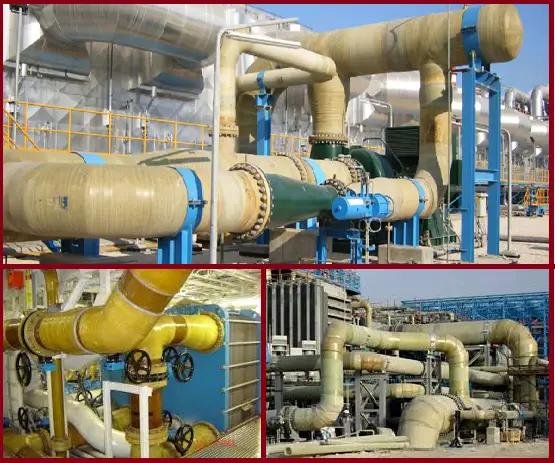
QA/QC in GRE, RTR, FRP & GRP Process Piping: A Complete Practical Guide for Oil & Gas and EPC Projects
Understand Composite Piping Materials, Jointing, Inspection, Testing and Quality Control
Non-metallic composite piping systems are widely used in Oil & Gas, Petrochemical, Refinery, LNG, Water Treatment, Power and industrial projects.
Unlike conventional carbon steel and stainless steel piping, composite piping systems are manufactured using reinforcing fibres combined with resin materials. These systems are selected for suitable applications because of their corrosion resistance, relatively low weight and specific mechanical and chemical properties.
GRE, RTR, FRP and GRP piping systems require specialised material inspection, handling, installation, jointing, curing and quality-control procedures.
A QA/QC Engineer working with these systems must understand the material characteristics, manufacturer’s requirements, approved jointing procedures, inspection methods, pressure testing and quality documentation.
This is particularly important in EPC projects where piping quality must comply with engineering specifications, applicable standards and client requirements.
At Petrotech Academy, our objective is to help engineering students, fresh graduates and working professionals understand the practical QA/QC activities involved in GRE/RTR/FRP/GRP piping installation and inspection.
1. What Is GRE, RTR, FRP and GRP Piping?
GRE, RTR, FRP and GRP are terms used for different types or classifications of fibre-reinforced polymer piping systems.
Although these terms are sometimes used interchangeably in industry, they are not always identical. Their meaning depends on the material system, resin, reinforcement and applicable project specification.
1. GRE – Glass Reinforced Epoxy
GRE stands for Glass Reinforced Epoxy.
It is a composite material made using glass-fibre reinforcement embedded in an epoxy resin matrix.
Common applications, subject to design suitability, include:
- Water injection systems.
- Cooling water systems.
- Seawater services.
- Firewater systems.
- Industrial utility piping.
- Selected chemical services.
<AsyncImage query=”GRE glass reinforced epoxy industrial process piping installation large diameter green composite pipes” aspectRatio=”16:9″ width=”100%”/>
2. RTR – Reinforced Thermosetting Resin
RTR refers to Reinforced Thermosetting Resin piping.
It is a broad classification for piping manufactured using reinforcing materials, such as glass fibres, combined with thermosetting resin systems.
Depending on the resin and reinforcement, RTR systems may be designed for different operating conditions and services.
3. FRP – Fibre Reinforced Plastic
FRP is a general term for composite materials made from reinforcing fibres embedded in a polymer resin matrix.
The fibres provide strength and stiffness, while the resin binds the reinforcement and contributes to the chemical and environmental resistance of the composite.
4. GRP – Glass Reinforced Plastic
GRP refers to Glass Reinforced Plastic piping, where glass fibres are used as reinforcement within a polymer resin matrix.
GRP is a widely used term in international composite piping standards, including ISO 14692.
Understanding the terminology
| Term | General meaning |
|---|---|
| GRE | Glass reinforcement with epoxy resin |
| RTR | Reinforced thermosetting resin |
| FRP | Fibre reinforced plastic |
| GRP | Glass reinforced plastic |
Important: The actual material composition, resin type, reinforcement, pressure rating and service suitability must be verified from the approved material specification and manufacturer documentation.
2. Where Is GRE/RTR/FRP/GRP Piping Used?
Composite piping systems are used in industrial applications where their material properties are suitable for the operating conditions.
Typical applications include:
- Oil & Gas processing facilities.
- Offshore platforms.
- Petrochemical plants.
- Refineries.
- LNG facilities.
- Water injection systems.
- Cooling water systems.
- Firewater networks.
- Seawater systems.
- Desalination plants.
- Industrial chemical handling.
- Wastewater treatment facilities.
<AsyncImage query=”industrial oil gas offshore platform GRE GRP composite piping firewater seawater pipe installation” aspectRatio=”16:9″ width=”100%”/>
The final selection of a composite piping system depends on design pressure, operating temperature, fluid composition, chemical compatibility, mechanical loading, fire requirements and the applicable engineering design basis.
3. What Is QA/QC in GRE/RTR/FRP/GRP Piping?
Quality Assurance and Quality Control are essential for ensuring that composite piping materials and installed systems meet specified quality requirements.
Unlike metallic piping, composite piping does not use conventional fusion welding for its joints. Its quality control focuses on the composite material, surface preparation, adhesive bonding, lamination, curing, joint integrity and installation.
Major responsibilities of a Composite Piping QA/QC Engineer
- Review approved project specifications and drawings.
- Verify manufacturer documentation and material certificates.
- Inspect incoming pipes, fittings and accessories.
- Verify pipe identification and traceability.
- Check storage and handling conditions.
- Review approved jointing procedures.
- Verify fitter and jointer qualifications, where required.
- Inspect pipe cutting and end preparation.
- Inspect adhesive-bonded joints.
- Inspect laminated joints.
- Monitor environmental and curing conditions.
- Verify pipe supports and installation.
- Review pressure testing procedures and reports.
- Maintain inspection records and joint registers.
- Coordinate with construction, engineering, manufacturer and client inspection teams.
- Verify final quality documentation and handover dossiers.
4. Understanding GRE/FRP Piping Materials and Components
Before starting inspection, a QA/QC Engineer should understand the different materials and components used in composite piping systems.
Common piping components
- Straight pipes.
- Elbows.
- Tees.
- Reducers.
- Flanges.
- Couplings.
- Stub ends.
- Saddles.
- Branch connections.
- Valves.
- Special fittings.
Important material characteristics
1. Resin System
The resin forms the matrix of the composite material. Common resin families include epoxy, polyester and vinyl ester, depending on the system design.
2. Glass Fibre Reinforcement
Glass fibres provide the reinforcement required for mechanical strength and stiffness.
3. Pressure Class
Defines the pressure rating of the piping system under specified design conditions.
4. Stiffness Class
Describes the resistance of the pipe to deformation under specified loading conditions, where applicable.
5. Pipe Construction
Composite pipe construction may involve different layers and reinforcement arrangements depending on the manufacturer and design.
<AsyncImage query=”GRE GRP FRP pipe cross section cutaway layers glass fiber resin composite pipe” aspectRatio=”16:9″ width=”100%”/>
The QA/QC Engineer should verify that the supplied materials match the approved technical submittals and project specifications.
5. Material Receiving Inspection (MIR)
Material Receiving Inspection is one of the first important QA/QC activities in a GRE/RTR/FRP piping project.
The objective is to confirm that the supplied materials comply with approved specifications and have not been damaged during manufacturing, transportation or delivery.
Materials commonly inspected
- GRE/GRP/FRP pipes.
- Elbows and tees.
- Reducers and couplings.
- Flanges and stub ends.
- Adhesives.
- Resin and hardener.
- Glass-fibre reinforcement.
- Jointing accessories.
- Gaskets and bolting materials.
Important inspection checks
A. Material identification
- Manufacturer name.
- Product identification.
- Pipe size and diameter.
- Pressure rating.
- Stiffness class, where specified.
- Resin type.
- Reinforcement details.
- Batch or production number.
B. Dimensional inspection
- Outside diameter.
- Inside diameter, where specified.
- Wall thickness.
- Pipe length.
- End dimensions.
- Fitting dimensions.
- Flange dimensions.
C. Visual inspection
- Cracks.
- Delamination.
- Impact damage.
- Surface defects.
- Exposed or damaged reinforcement.
- Resin-rich or dry-fibre areas, where identifiable.
- Transportation damage.
- Damage to pipe ends and joint surfaces.
D. Document verification
- Material certificates.
- Manufacturer’s data sheets.
- Product identification records.
- Inspection and test certificates.
- Approved technical submittals.
- Batch and traceability records.
<AsyncImage query=”GRE GRP fiberglass pipe material receiving inspection quality control engineer checking composite pipe dimensions warehouse” aspectRatio=”16:9″ width=”100%”/>
Materials showing damage or discrepancies should be identified, segregated where necessary and processed in accordance with the project’s non-conformance procedure.
6. Storage and Handling Inspection
Proper storage and handling are important because composite piping can be damaged by impact, incorrect lifting, excessive loading and unsuitable environmental conditions.
Important storage requirements
- Store pipes on suitable supports.
- Follow the manufacturer’s stacking recommendations.
- Prevent direct contact with sharp objects.
- Protect pipe ends and jointing surfaces.
- Keep pipes away from harmful chemicals and contamination.
- Follow specified temperature and environmental conditions.
- Protect materials from excessive sunlight or UV exposure where required.
- Store adhesives and resin materials according to manufacturer instructions.
- Check shelf life and batch identification.
- Maintain material traceability during storage.
Important handling requirements
- Use approved lifting equipment.
- Use suitable slings and lifting arrangements.
- Avoid dropping or dragging pipes.
- Prevent impact damage.
- Avoid excessive bending or local loading.
- Follow manufacturer handling procedures.
<AsyncImage query=”industrial GRE GRP composite pipes proper storage wooden supports warehouse lifting crane nylon slings” aspectRatio=”16:9″ width=”100%”/>
A QA/QC Engineer should verify that storage and handling comply with the approved project procedures and manufacturer recommendations.
7. GRE/RTR/FRP Piping Jointing Methods
Jointing is one of the most important quality-control activities in composite piping installation.
Unlike metallic piping, GRE/RTR/FRP piping does not normally use conventional welding to connect pipe sections. Different joining systems are used depending on the manufacturer, piping design and application.
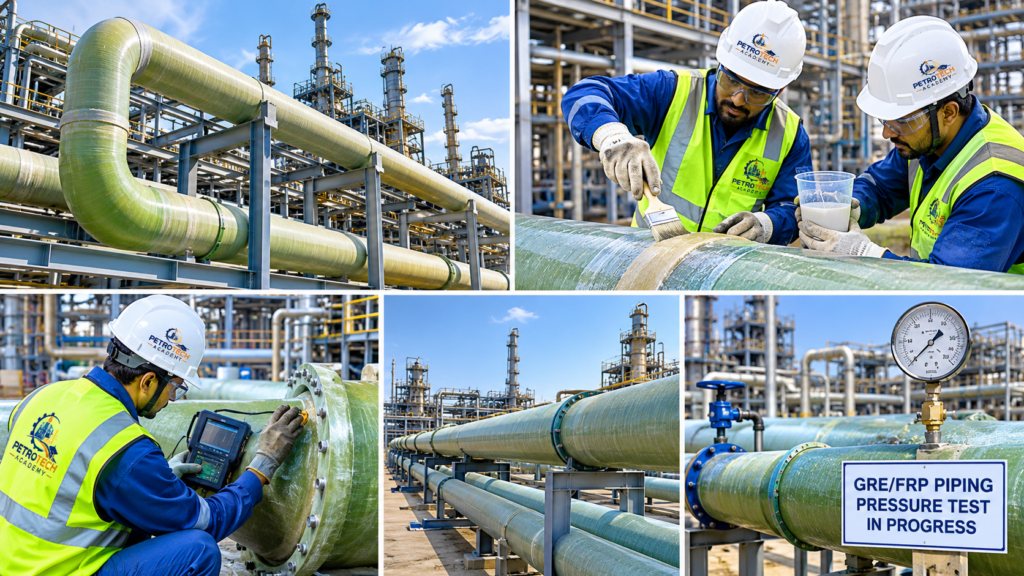
Common composite piping jointing methods
1. Adhesive-Bonded Joint
An adhesive is used to connect compatible pipe and fitting surfaces.
The process involves:
- Pipe cutting.
- End preparation.
- Surface preparation.
- Adhesive preparation.
- Adhesive application.
- Joint assembly.
- Alignment.
- Curing.
<AsyncImage query=”GRE fiberglass epoxy pipe adhesive bonded bell spigot joint assembly industrial installation” aspectRatio=”16:9″ width=”100%”/>
2. Laminated Joint – Butt-and-Wrap Joint
This joining method uses reinforcement fibres and resin applied over prepared pipe ends to create a structural joint.
Typical activities include:
- Pipe end preparation.
- Alignment and gap control.
- Surface preparation.
- Reinforcement material preparation.
- Resin preparation.
- Lamination application.
- Curing.
- Final inspection.
<AsyncImage query=”GRP FRP fiberglass pipe butt and wrap laminated joint technician applying glass fiber resin” aspectRatio=”16:9″ width=”100%”/>
3. Flanged Joint
Flanged connections are used where removable connections are required.
Important checks include:
- Flange type and rating.
- Facing and alignment.
- Gasket compatibility.
- Bolt and nut specifications.
- Correct tightening sequence.
- Manufacturer-specified bolt torque.
- Avoidance of excessive loads.
4. Mechanical Joint
Certain composite piping systems use specially designed mechanical couplings or other manufacturer-approved connection arrangements.
Inspection must follow the applicable system-specific procedure.
8. QA/QC Inspection of Adhesive-Bonded Joints
Adhesive bonding is a critical process in many GRE/RTR piping systems.
The quality of the joint depends on correct preparation, material compatibility, adhesive handling, environmental conditions, assembly and curing.
Step 1: Verify the Approved Jointing Procedure
Before commencing work, verify:
- Approved jointing procedure.
- Manufacturer’s installation instructions.
- Qualified jointing procedure, where required.
- Personnel qualifications.
- Approved adhesive and compatible components.
- Required inspection records.
Step 2: Pipe Cutting and End Preparation
Important inspection checks include:
- Correct pipe length.
- Square cutting.
- Correct joint dimensions.
- Surface preparation.
- Removal of contamination.
- Correct insertion depth or joint engagement.
Step 3: Adhesive Preparation
Verify:
- Correct adhesive identification.
- Batch number.
- Expiry date.
- Storage condition.
- Mixing ratio, where applicable.
- Mixing procedure.
- Pot life and working time.
- Manufacturer’s temperature requirements.
Step 4: Adhesive Application and Joint Assembly
Inspect:
- Adhesive application.
- Correct joint assembly.
- Insertion depth.
- Pipe alignment.
- Joint identification.
- Compliance with the approved procedure.
Step 5: Curing Inspection
Verify:
- Ambient temperature.
- Relative humidity, where specified.
- Curing temperature.
- Curing time.
- Protection during curing.
- Compliance with manufacturer requirements.
<AsyncImage query=”GRE GRP composite pipe adhesive jointing technician pipe spigot bell joint quality inspection” aspectRatio=”16:9″ width=”100%”/>
A joint must not be loaded, moved or pressure-tested before the required curing conditions and release requirements are satisfied.
9. QA/QC Inspection of Laminated Joints
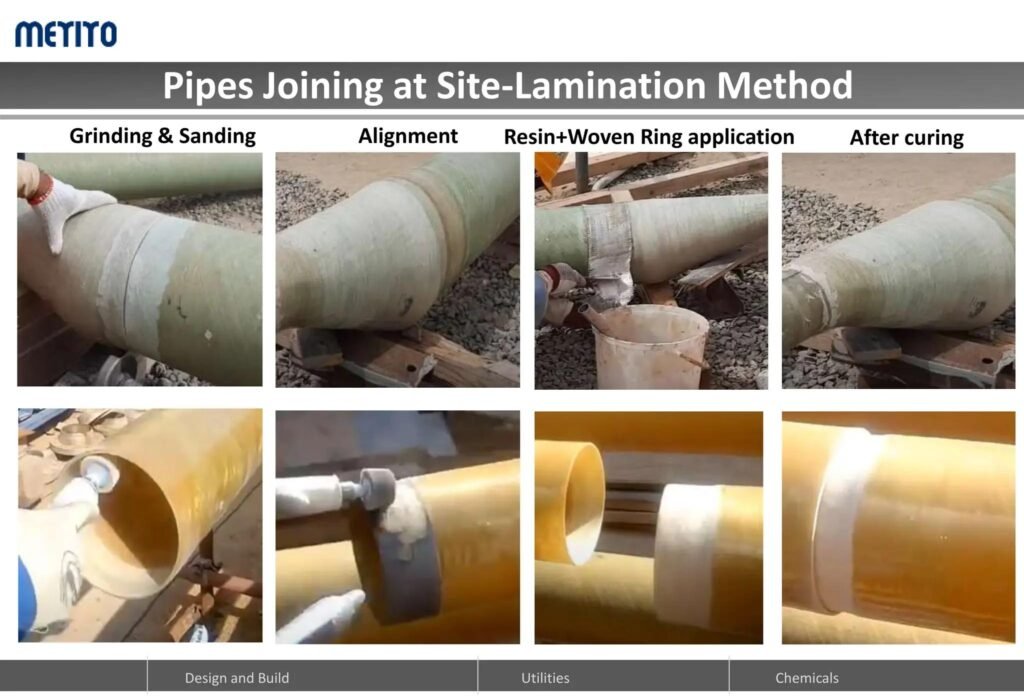
Laminated joints are commonly used in certain composite piping systems and require controlled preparation and workmanship.
The joint is created by applying resin-impregnated reinforcement layers according to the approved jointing procedure.
Important inspection activities
1. Surface Preparation
- Verify pipe-end preparation.
- Check surface cleanliness.
- Confirm required surface profile.
- Ensure removal of contamination.
- Verify prepared joint dimensions.
2. Reinforcement Verification
- Confirm correct reinforcement type.
- Verify reinforcement material identification.
- Check required layer sequence.
- Confirm dimensions and overlap requirements.
3. Resin Preparation
- Verify resin type.
- Check batch number and expiry date.
- Verify mixing ratio.
- Confirm catalyst or hardener requirements.
- Check pot life and working time.
4. Lamination Application
- Verify reinforcement placement.
- Check resin impregnation.
- Monitor workmanship.
- Avoid air entrapment.
- Verify laminate dimensions and thickness as specified.
- Maintain joint identification.
5. Curing Inspection
- Verify curing temperature.
- Record curing duration.
- Check environmental conditions.
- Confirm compliance with the approved procedure.
- Release the joint only after the required acceptance checks.
<AsyncImage query=”industrial FRP GRP pipe lamination joint glass fiber reinforcement resin application close up technician” aspectRatio=”16:9″ width=”100%”/>
The required laminate construction and acceptance criteria must be taken from the approved jointing procedure and manufacturer requirements.
10. Common Defects and Quality Concerns in GRE/FRP Piping
A composite piping QA/QC Engineer should understand the typical defects and installation problems that can affect joint integrity and system performance.
| Defect or concern | General description |
|---|---|
| Delamination | Separation between composite layers |
| Cracking | Visible cracks in the pipe or joint |
| Dry fibre | Reinforcement that has not been adequately wetted by resin |
| Resin-rich area | Local area with excessive resin relative to reinforcement |
| Air voids | Trapped air within a laminate |
| Poor bonding | Inadequate bond between joining surfaces |
| Incorrect joint alignment | Misalignment between connected components |
| Incomplete curing | Failure to achieve specified curing requirements |
| Surface damage | Scratches, impact damage or damaged reinforcement |
| Contamination | Dirt, oil or other unwanted material on prepared joint surfaces |
What should a QC Inspector do?
- Identify and record the defect.
- Check the applicable acceptance criteria.
- Notify the responsible construction or quality representative.
- Raise an NCR where required.
- Obtain an approved repair procedure.
- Verify repair activities.
- Complete re-inspection and documentation.
Repairs must not be performed using informal methods. They should follow approved manufacturer procedures and project requirements.
11. Installation Inspection of GRE/RTR/FRP Piping
After fabrication and jointing, composite piping spools are installed at the project site.
The QC Engineer must verify that the installed piping complies with the approved drawings and installation procedures.
Important installation checks
- Correct piping route.
- Line number and identification.
- Pipe support locations.
- Support type and spacing.
- Correct guide and anchor arrangements.
- Flange orientation.
- Alignment and slope.
- Equipment connection details.
- Expansion and flexibility requirements.
- Clearance from other services.
- Protection against external damage.
- Compliance with approved isometric drawings.
<AsyncImage query=”industrial GRE GRP fiberglass composite process piping installed pipe rack supports water treatment plant” aspectRatio=”16:9″ width=”100%”/>
Important support considerations
Composite piping systems require support arrangements designed for their specific mechanical characteristics.
Inspectors should verify:
- Correct support type.
- Contact surface and support width.
- Approved support spacing.
- Suitable restraint arrangements.
- Avoidance of concentrated loads.
- Protection against abrasion.
- Correct anchor and guide installation.
- Compliance with manufacturer and engineering requirements.
Incorrect support arrangements can cause excessive stress, deformation or damage to composite piping.
12. Pressure Testing of GRE/RTR/FRP/GRP Piping
Pressure testing is an important stage of composite piping quality control.
It is performed to verify the integrity of the installed piping system and its joints in accordance with the approved test procedure and applicable design requirements.
The test medium, pressure, duration and acceptance criteria must be established by the responsible engineering team and approved for the specific piping system.
Before Pressure Testing
- Review the approved pressure test procedure.
- Verify the test package and test boundaries.
- Confirm jointing completion.
- Verify required adhesive or laminate curing.
- Inspect piping supports and restraints.
- Verify temporary blinds and test connections.
- Check pressure gauge calibration.
- Confirm the approved test medium.
- Verify safety precautions and exclusion zones.
During Pressure Testing
- Fill the system as specified.
- Remove trapped air where required.
- Increase pressure in a controlled manner.
- Monitor pressure and duration.
- Inspect joints and connections.
- Check for leakage or abnormal deformation.
- Record the test results.
After Pressure Testing
- Verify test acceptance.
- Prepare pressure test reports.
- Drain and dry the system where required.
- Complete reinstatement.
- Verify punch-list clearance.
- Update the test package and quality records.
<AsyncImage query=”industrial GRE GRP FRP composite piping hydrostatic pressure testing pressure gauge manifold” aspectRatio=”16:9″ width=”100%”/>
Pressure testing of composite piping must follow the approved procedure. Test pressures and durations should never be copied from metallic piping requirements without confirming their suitability for the composite system.
13. Electrical Conductivity and Earthing Requirements
Composite piping is often electrically insulating, but some systems may have specified conductive or electrostatic-dissipative properties.
Where electrical conductivity or earthing requirements are included in the design, QA/QC must verify compliance with the system designer’s documentation and applicable project requirements.
Typical checks may include:
- Conductive pipe identification.
- Approved conductive components.
- Earthing or bonding arrangements.
- Electrical continuity testing, where specified.
- Earth resistance verification, where required.
- Inspection and documentation of earthing connections.
Not every GRE/GRP piping system requires the same electrical treatment. Requirements depend on the fluid, electrostatic hazard assessment and piping system design.
14. Inspection and Test Plan (ITP) for GRE/RTR/FRP Piping
An Inspection and Test Plan defines the quality-control activities and inspection requirements at different stages of composite piping construction.
Example of a simplified composite piping ITP
| Activity | Typical inspection requirement |
|---|---|
| Material receiving | Material identification and certificate verification |
| Storage and handling | Manufacturer’s storage and handling compliance |
| Pipe cutting | Length and end preparation |
| Surface preparation | Cleanliness and specified surface condition |
| Adhesive preparation | Material identification, batch and mixing verification |
| Adhesive bonding | Joint assembly and alignment |
| Lamination | Reinforcement, resin application and workmanship |
| Curing | Temperature and time verification |
| Installation | Routing, supports and alignment |
| Pressure testing | Approved test procedure and acceptance |
| Final inspection | Completion and handover verification |
Inspection points may include:
- H – Hold Point: Work cannot proceed beyond the specified stage without the required release.
- W – Witness Point: The designated party is notified and may witness the activity.
- R – Review Point: Required records and documents are reviewed.
- S – Surveillance: Activities are monitored through periodic observation.
The actual inspection points, responsibilities and acceptance criteria must follow the approved project ITP.
15. Important International Standards for GRE/RTR/FRP/GRP Piping
A Composite Piping QA/QC Engineer should understand the applicable international standards and project specifications.
The following are important references:
| Standard | General application |
|---|---|
| ISO 14692-1 | GRP piping vocabulary, symbols, applications and materials |
| ISO 14692-2 | Qualification and manufacture of GRP piping |
| ISO 14692-3 | System design of GRP piping |
| ISO 14692-4 | Fabrication, installation and operation of GRP piping |
| ASTM D2996 | Filament-wound glass-fibre-reinforced thermosetting-resin pipe |
| ASTM D2997 | Centrifugally cast glass-fibre-reinforced thermosetting-resin pipe |
| ASTM D3517 | Glass-fibre-reinforced thermosetting-resin pressure pipe |
| ASTM D1599 | Short-time hydraulic pressure testing of plastic pipe, tubing and fittings |
The applicable standards depend on the piping system, manufacturing method, application and project specification. These references are not interchangeable, and the latest applicable edition should be confirmed before use.
16. Important QA/QC Documents for Composite Piping
Documentation is a major responsibility of the Composite Piping QA/QC team.
Important records include:
- Quality Assurance Plan (QAP).
- Inspection and Test Plan (ITP).
- Approved Material Submittals.
- Manufacturer’s Data Sheets.
- Material Test Certificates.
- Manufacturer’s Qualification Records.
- Jointing Procedure Specifications.
- Jointing Procedure Qualification Records, where required.
- Fitter and Jointer Qualification Records.
- Adhesive and Resin Batch Records.
- Material Receiving Inspection Reports.
- Storage and Handling Inspection Records.
- Joint Preparation Inspection Reports.
- Adhesive Bonding Inspection Reports.
- Lamination Inspection Reports.
- Curing Records.
- Joint Registers.
- Installation Inspection Reports.
- Pressure Test Packages.
- Non-Conformance Reports (NCRs).
- Repair and Re-inspection Records.
- As-Built Drawings.
- Final Quality Dossier.
A competent QA/QC Engineer must understand not only how to inspect the work but also how to maintain traceability and demonstrate compliance through documentation.
17. Difference Between Metallic and GRE/RTR/FRP Piping QA/QC
Understanding the difference between metallic and composite piping inspection is important for engineers working in multidisciplinary EPC projects.
| Parameter | Metallic Process Piping | GRE/RTR/FRP/GRP Piping |
|---|---|---|
| Main material | Steel and metallic alloys | Glass fibres and polymer resin |
| Typical joining | Welding, flanges and mechanical joints | Adhesive bonding, lamination, flanges and approved mechanical joints |
| Main inspection focus | Material, fit-up, welding and NDT | Material, surface preparation, jointing and curing |
| Welding documents | WPS, PQR and welder qualification | Jointing procedures and personnel qualifications |
| NDT | VT, PT, MT, RT and UT as specified | Visual and system-specific examination; conventional weld NDT is generally not applicable |
| Main joint quality concerns | Weld discontinuities and workmanship | Bonding quality, laminate defects and curing |
| Pressure testing | Approved piping code and test procedure | Approved composite piping design and manufacturer-specific procedure |
| Material traceability | Heat numbers and material certificates | Manufacturer, product, batch and component traceability |
The two piping systems require different inspection competencies. A QA/QC professional should not apply metallic welding inspection procedures directly to composite piping.
18. Career Opportunities in GRE/RTR/FRP/GRP Piping QA/QC
Composite piping is used in a range of industrial applications, creating opportunities for professionals who understand its materials, installation requirements and quality-control procedures.
Potential job titles include:
- Junior QA/QC Engineer.
- GRP/GRE Piping QC Inspector.
- Composite Piping Inspector.
- Mechanical QA/QC Engineer.
- FRP Piping QC Engineer.
- QA/QC Supervisor.
- Composite Piping Installation Inspector.
- Quality Engineer.
- QA/QC Coordinator.
Actual job eligibility depends on the employer’s requirements, relevant qualifications, experience and any required specialist training or certification.
Opportunities for Different Engineering Backgrounds
Mechanical Engineering Graduates
Mechanical graduates can develop knowledge in composite piping materials, jointing, inspection, installation, pressure testing and quality documentation.
Civil Engineering Graduates
Civil graduates can develop relevant knowledge in pipe supports, foundations, underground composite piping, pipe racks and installation interfaces. Dedicated composite piping inspection roles may require additional piping-specific preparation.
Electrical Engineering Graduates
Electrical graduates can learn about composite piping interfaces, conductive piping requirements, earthing and bonding where specified, and multidisciplinary quality coordination. Specialist piping inspection roles require additional composite piping knowledge.
Diploma Holders and Working Professionals
Diploma holders, supervisors, construction personnel and professionals working in installation, maintenance and quality can strengthen their understanding of composite piping inspection and documentation.
19. Why Learn GRE/RTR/FRP/GRP Piping QA/QC at PetroTech Academy?
Composite piping QA/QC requires specialised knowledge that is different from conventional metallic piping inspection.
Understanding only the names of materials and jointing methods is not enough. Engineers should understand how composite piping is received, stored, prepared, joined, inspected, tested and documented in real industrial projects.
At Petrotech Academy, our training approach aims to connect engineering fundamentals with practical industrial requirements.
Our Composite Piping QA/QC Training Covers
- Introduction to GRE/RTR/FRP/GRP piping.
- Composite materials and resin systems.
- Pipe construction and material identification.
- Manufacturer documentation and specifications.
- Material receiving inspection.
- Storage and handling requirements.
- Pipe cutting and surface preparation.
- Adhesive-bonded joint inspection.
- Laminated joint inspection.
- Flanged and mechanical joint inspection.
- Curing requirements and inspection.
- Common composite piping defects.
- Pipe support and installation inspection.
- Pressure testing and documentation.
- ITP and method statement understanding.
- NCR and quality dossier preparation.
- Technical interview preparation.
Who Should Join?
- B.Tech and Diploma engineering students.
- Fresh Mechanical Engineering graduates.
- Civil Engineering graduates interested in industrial QA/QC.
- Electrical Engineering graduates interested in multidisciplinary EPC quality.
- Job seekers targeting Oil & Gas and EPC industries.
- Site and construction engineers.
- Working QA/QC professionals.
- Piping supervisors and installation personnel.
Start Your GRE/RTR/FRP/GRP Piping QA/QC Learning Journey
Composite piping quality depends on correct materials, controlled jointing, proper curing, suitable installation and effective inspection.
From material receiving and storage to adhesive bonding, lamination, pressure testing and final handover, a Composite Piping QA/QC Engineer plays an important role in ensuring piping system integrity and compliance.
Whether you are a fresher beginning your engineering career or an experienced professional looking to expand your technical knowledge, learning composite piping QA/QC can strengthen your understanding of specialised industrial piping systems.
Understand the Materials. Inspect the Joints. Verify the Curing. Ensure Quality.
Join Petrotech Academy and develop your knowledge of GRE/RTR/FRP/GRP Process Piping QA/QC for Oil & Gas and EPC projects.
“Metallic piping is inspected through welding and NDT requirements. Composite piping demands specialised knowledge of materials, bonding, lamination and curing. Learn both disciplines with industry-oriented training at PetroTech Academy.”
PETROTECH ACADEMY
Empowering People | Enhancing Skills | Building Futures
🌐 Website: https://www.petrotechacademy.com/
📧 Email: info@petrotechacademy.com
Enquire today about our GRE/RTR/FRP/GRP Piping QA/QC training programme.
Our training aims to develop technical knowledge and practical understanding. Employment, inspection appointments and certification eligibility depend on individual qualifications, experience, applicable certification requirements and employer selection.